Role Definition
The solution architect is responsible for the design of the software solution.
In this role, the solution architect is responsible not only for coding the solution, but also for the following topics:
-
Architectural Design Patterns
- Microservices and API Design
- Security and Compliance
- Performance and Scalability
- Monitoring and Logging
- Testing and QA
-
Data Strategy and Data Management
-
DevOps and CI/CD Pipelines
- Containers and Orchestration
-
Infrastructure (cloud or on-prem)
- Infrastructure as Code (IaC)
-
Documentation and Communication
- Technical Documentation
- User Documentation
- API Documentation
- Architecture Documentation
- Data Documentation
- Security Documentation
- Compliance Documentation
- Performance Documentation
- Monitoring Documentation
-
Project Management and Leadership
- Planning and Estimation
- Tracking and Reporting
- Review and Closure
- Documentation and Communication
- Leadership and Management
Microservices and API Design
Microservice architecture is one of the most popular architectural patterns for building scalable and maintainable software solutions.
Microservices are a set of small, independent services that can be developed, deployed, and scaled independently. Along with API Design, they form the backbone of modern software architectures.
On the other hand, API Design is the design of the API that will be used to communicate between the services.
Data Strategy and Data Management
Data Strategy is the strategy for the data management of the software solution.
Phase 1: Architectural Patterns & Design
Goal: Prove you can design scalable, decoupled systems.
Microservices vs. Monolith
Be ready to explain when not to use microservices. The distributed monolith is a common failure mode interviewers look for.
Domain-Driven Design (DDD)
-
Bounded Contexts: How to define service boundaries (this is crucial to avoid tight coupling).
-
Aggregates, Entities, Value Objects: How to structure internal logic.
Question: How do you identify bounded contexts in a legacy monolith?
Ready Answer: Analyze business capabilities, identify natural seams in the codebase, and look for areas with distinct data models or workflows.
Question: What define the equality operator for Identity vs Value Object?
Ready Answer: Identity objects are compared by their unique identifier (ID), while Value Objects are compared based on their attributes or properties.
Design Patterns
-
CQRS (Command Query Responsibility Segregation): Separating reads from writes for performance.
-
Mediator Pattern: Using MediatR or Mediator.cs for internal communication between services.
-
Event Sourcing: Storing state as a sequence of events (often paired with CQRS).
-
BFF (Backend for Frontend): Creating specific API gateways for different clients (Web, Mobile).
Resilience Patterns
-
Circuit Breaker: Preventing cascading failures (know Polly library for .NET).
-
Retry & Exponential Backoff: Handling transient faults.
-
Bulkhead: Isolating resources so one failure doesn’t crash the whole system.
Phase 2: The .NET Core Ecosystem
Goal: Show deep expertise in the primary technology stack.
Communication Protocols
-
Synchronous: REST APIs (WebAPI) vs. gRPC (essential for high-performance inter-service communication).
-
Asynchronous: Message Brokers (RabbitMQ, Azure Service Bus, Kafka). Know MassTransit or NServiceBus.
.NET Specifics
-
Dependency Injection (DI) scopes: Singleton vs. Scoped vs. Transient (architectural impact on memory/concurrency).
-
Middleware Pipeline: How to write custom middleware for cross-cutting concerns (logging, auth).
-
Health Checks: Implementing /health /liveness and /readiness probes for orchestrators like Kubernetes.
API Gateways
-
Role: Routing, Authentication, Rate Limiting, SSL Termination.
-
Tools: YARP (Yet Another Reverse Proxy) (Microsoft’s current standard) or Ocelot.
Question: When would you use gRPC over REST?
Ready Answer: Use gRPC for high-performance, low-latency communication between internal microservices, especially when you need strong typing and support for streaming. REST is better suited for public APIs where human readability and broad client support are priorities.
Question: What is the difference between Scoped and Transient services in .NET Dependency Injection?
Ready Answer:
-
Scoped servicesare created once per client request (or scope), meaning they are shared within that request but not across requests.-
Transient servicesare created each time they are requested, so a new instance is provided every time they are injected.-
Singleton servicesare
Question: What is a .NET Generics?
Ready Answer: Generics in .NET allow you to define classes, interfaces, and methods with a placeholder for the data type. This enables code reusability and type safety, as you can create data structures and algorithms that work with any data type without sacrificing performance or safety.
Phase 3: Data Strategy (SQL Server)
Goal: Address the hardest part of distributed systems — state.
-
Database-per-Service:
The golden rule. Explain how to break foreign key dependencies between services (hint: use IDs and eventual consistency, not cross-database joins). -
Distributed Transactions:
-
Saga Pattern:
Orchestration(central controller) vs.Choreography(event-driven). This replaces 2-Phase Commit (2PC). -
CAP Theorem: Explain why you might choose
AvailabilityoverConsistencyorPartition Tolerance(Eventual Consistency is a form of Availability over Consistency).
-
-
Performance
- Indexing strategies in SQL Server: Clustered Index, Non-Clustered Index, Covering Index, Filtered Index, Index Intersection, Index Seek, Index Scan, Index Merge, Index Covering, Index Filtering, Index Optimization, Index Rebuilding, Index Reorganizing, Index Statistics, Index Maintenance, Index Monitoring, Index Tuning, Index Performance, Index Analysis, Index Recommendations, Index Best Practices, Index Optimization Techniques, Index Performance Optimization, Index Performance Tuning, Index Performance Analysis, Index Performance Recommendations, Index Performance Best Practices, Index Performance Techniques, Index Performance Optimization Techniques, Index Performance Tuning Techniques, Index Performance Analysis Techniques, Index Performance Recommendations Techniques, Index Performance Best Practices Techniques.
-
EF Core Optimization: Tracking vs. No-Tracking, Split Queries, Projection (.Select()).
-
Caching: Distributed caching (Redis) vs. In-memory caching.
Phase 4: DevOps & Containerization
Goal: Demonstrate you understand the “Path to Production”.
-
Containerization (Docker): How to create a Dockerfile and how to build a container image.
-
Multi-stage builds: Optimizing image size (e.g., using alpine or chiseled images).
-
Difference between Image, Container, and Registry (ACR/Docker Hub): How to create a Docker image, how to create a Docker container, how to create a Docker registry.
-
Orchestration (Kubernetes/K8s): How to create a Kubernetes cluster, how to create a Kubernetes deployment, how to create a Kubernetes service, how to create a Kubernetes ingress.
- Pods, Services, Deployments, Ingress: The basic building blocks.
- Sidecar Pattern: (e.g., Dapr or Envoy) for abstracting communication/logging.
-
Config Management: ConfigMaps and Secrets (and how to use KeyVault instead of env variables).
-
CI/CD Pipelines
- Build:
Build the solution->Scan for package vulnerabilities->Unit tests->Build Docker Image->Scan for container vulnerabilities->Push to Registry. - Release:
Deploy to Dev->Integration Tests->Promote to QA->Promote to Prod.
- Build:
- Deployment Strategies: Strategies to minimize downtime:
Blue/GreendeploymentCanarydeploymentRollingdeploymentBlue/Greendeployment with Kubernetes
Phase 5: Observability
Goal: How do you know it’s broken before the customer calls?
The Three Pillars of Observability
- Logging: Structured logging (Serilog) sent to ELK/Seq/AppInsights. Logging is used to track application behavior and to troubleshoot issues.
Example of structured logging:
  {
    "timestamp": "2025-01-01T00:00:00.000Z",
    "level": "INFO",
    "message": "User logged in",
    "userId": "1234567890"
  }
Example of error logging with context:
  {
    "timestamp": "2025-01-01T00:00:00.000Z",
    "level": "ERROR",
    "message": "Failed to process order",
    "orderId": "ORD-12345",
    "userId": "1234567890",
    "exception": "System.InvalidOperationException",
    "stackTrace": "..."
  }
Example of performance logging:
  {
    "timestamp": "2025-01-01T00:00:00.000Z",
    "level": "INFO",
    "message": "API request completed",
    "endpoint": "/api/orders",
    "method": "POST",
    "duration": 250,
    "statusCode": 201
  }
-
Metrics : CPU, Memory, Request Latency (Prometheus/Grafana). Metrics are used to track application performance and to troubleshoot issues.
Example of metrics:
{ "timestamp": "2025-01-01T00:00:00.000Z", "cpu": 50, "memory": 100, "requestLatency": 100 } -
Tracing: OpenTelemetry (standard in .NET now). Visualizing a request as it hops between 5 different microservices (Correlation IDs). Tracing is used to track application behavior and to troubleshoot issues.
Example of tracing:
{
  "traceId": "1234567890",
  "spanId": "1234567890",
  "parentSpanId": "1234567890",
  "operationName": "GetUser",
  "startTime": "2025-01-01T00:00:00.000Z",
  "endTime": "2025-01-01T00:00:00.000Z",
  "duration": 100
}
Top 5 Interview Questions to Expect
-
How do you handle a transaction that spans two different microservices (e.g., Order and Inventory)?- Answer Guide: Do not suggest a distributed transaction (MSDTC). Propose the Saga Pattern (Order Created -> Reserve Inventory -> If Fail -> Compensating Transaction to Cancel Order).
-
We have a slow SQL query in a monolithic stored procedure. How do we migrate this to microservices?- Answer Guide: Identify the bounded context. Extract the logic to code (EF Core/Dapper). Implement caching (Redis). If read-heavy, suggest CQRS with a read-optimized replica.
-
How do you prevent one microservice from taking down the whole system if it creates a loop of requests?- Answer Guide: Discuss Circuit Breakers (stop calling the failing service) and Rate Limiting.
-
REST vs. Message Queues: How do you decide which to use?- Answer Guide: Use REST/gRPC when the client needs an immediate answer (Query). Use Messaging (Queues) for state changes (Commands) to decouple systems and handle load spikes.
-
How do you manage configuration across Dev, QA, and Prod environments in Kubernetes?- Answer Guide: Helm Charts, Kustomize, or external configuration stores (Azure App Config) injected as environment variables or volume mounts.
Helm Charts are the best way to manage configuration across Dev, QA, and Prod environments in Kubernetes.
Phase 6: Testing
Goal: Show deep expertise in testing.
Testing Pyramid
The testing pyramid is a model that suggests the different types of tests should be in a specific ratio. It is a way to balance the different types of tests and to ensure that the tests are comprehensive and effective.
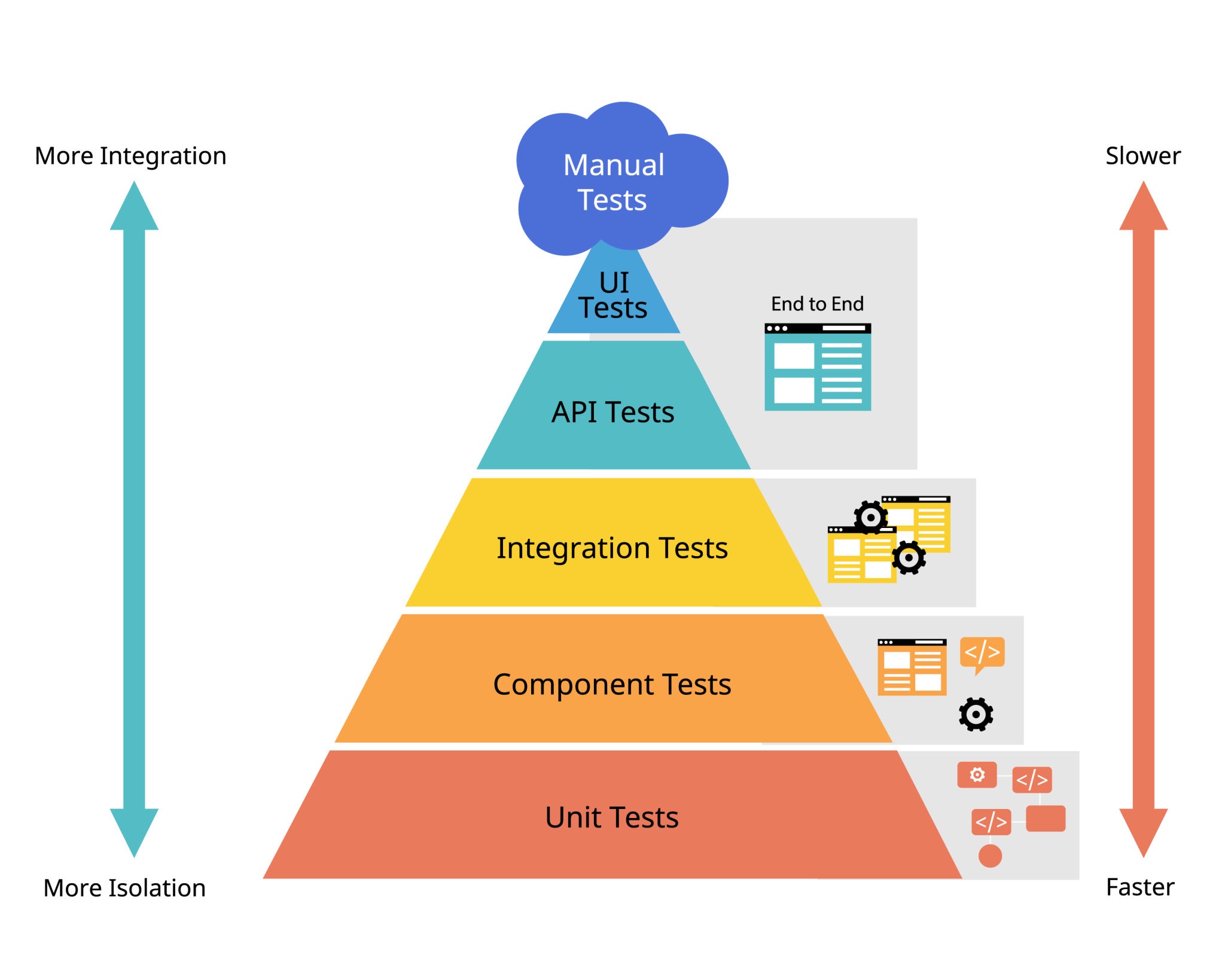
Test coverage should be:
Unit Tests:        100%
Integration Tests:  80%
E2E Tests:          50%
Testing Types
- Unit Tests: Tests the smallest units of code.
- Integration Tests: Tests the integration of the different units of code.
- E2E Tests: Tests the end to end flow of the application.
- BDD Tests: Tests the behavior of the different units of code.
- Contract Tests: Tests the contracts of the different units of code.
- Component Tests: Tests the components of the different units of code.
3A Principles
The 3A principles are a way to test the code. They are:
- Arrange: Arrange the test data and the test environment.
- Act: Act on the test data and the test environment.
- Assert: Assert the expected result.
Test Libraries
Unit Tests
Unit tests are used to test the smallest units of code. They are typically fast to run and can be run independently.
- xUnit: A unit testing framework for .NET.
- NUnit: A unit testing framework for .NET.
Integration Tests
Integration tests are used to test the integration of the different units of code. They are typically slower to run and can be run independently.
- NSubstitute: A mocking framework for .NET.
- Shouldly: An assertion library for .NET.
- FluentAssertions: A fluent assertion library for .NET.
-
AutoFixture: A fixture builder for .NET.
- AutoMoq: A mocking framework for .NET.
- AutoFakeItEasy: A mocking framework for .NET.
- AutoNSubstitute: A mocking framework for .NET.
- AutoShouldly: A mocking framework for .NET.
- AutoFluentAssertions: A mocking framework for .NET.
BDD Tests
Behavior Driven Development (BDD) tests are used to test the behavior of the different units of code. They are typically slower to run and can be run independently.
- Reqnroll: A Behavior Driven Development (BDD) testing framework for .NET. It’s a modern alternative to
SpecFlow.
Contract Tests
Contract tests are used to test the contracts of the different units of code. They are typically slower to run and can be run independently.
- Pact: A contract testing framework for .NET.
Component Tests
Component tests are used to test the components of the different units of code. They are typically slower to run and can be run independently. A well known framework is Testcontainers. It allows to test the components of the different units of code in a containerized environment.
- Testcontainers: A container testing framework for .NET .